"Only Freedom Precedes Freedom": Existence and Christianity in the Philosophy of Luigi Pareyson
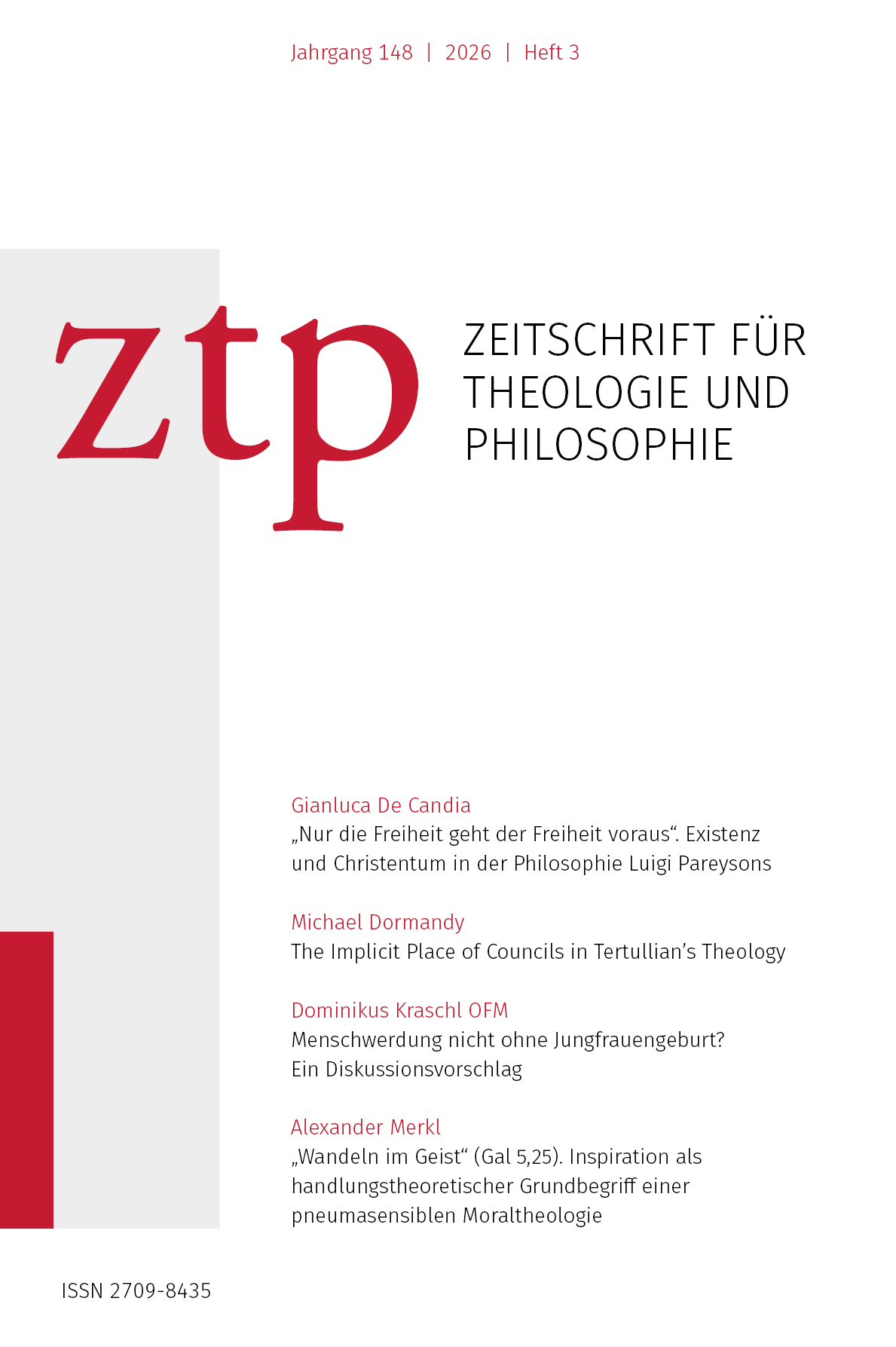
Published 2026-09-01
Keywords
- Luigi Pareyson,
- F. W. J. Schelling,
- Søren Kierkegaard,
- Karl Barth,
- immanence and transcendence
- positive and negative philosophy,
- divine freedom ...More
Abstract
Luigi Pareyson (1918–1991) locates the essential legacy of existentialism in the stark opposition between positive and negative – an opposition that appears as an unbridgeable alternative and that, in his view, emerged from the collapse of the Hegelian system. Within this frame, he reads Søren Kierkegaard’s philosophy of existence, in which the concepts of opposition and immeasurability between the finite and the absolute are juxtaposed and gain a newfound relevance through Karl Barth’s “dialectical theology”. In contradistinction to Barth, however, he introduces the thesis of a reciprocal “implication of negative and positive”, which he develops as a dialectic of immeasurability and participation in the tension between immanence and transcendence. This figure of thought informs his “ontological personalism” as well as his philosophical hermeneutics and finds its apogee – drawing on Schelling’s late “positive” philosophy – in the insight that even divine freedom remains inextricably bound to the problem of the negative. This results in a radical revision of the traditional metaphysical conceptions of God, which Pareyson unmasks as “conceptual anthropomorphism”. At the same time, he identifies central problems concerning the God of Christian religious experience, especially regarding divine freedom as it pertains to evil and suffering as well as the scope of the “word of reconciliation” (2 Cor 5:19) as a hermeneutic key for a universalist interpretation of Christian existence.